

Photo: Finnish National Gallery / Yehia Eweis
The Modern Woman
Helene Schjerfbeck (1862–1946)
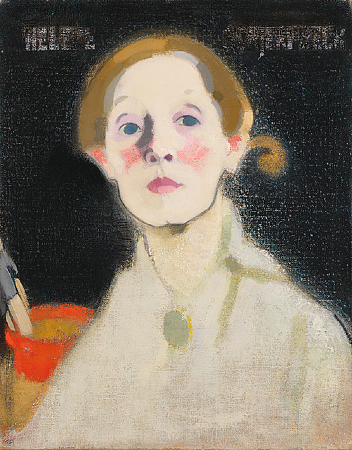
Self-Portrait, Black Background
1915
oil on canvas
Collection Herman & Elisabeth Hallonblad,
Ateneum Art Museum, Finnish National Gallery
Read more
In 1914, the Finnish Art Society commissioned self-portraits from ten leading artists for its Board Room. Helene Schjerfbeck was one of the artists and the only woman. Her piece, Self Portrait, Black Background, was presented in 1915. Depicting the artist en face in clear white and vermilion, the worn silver letters above her head starkly contrast with the black background, resembling a gravestone as intended by the artist herself.
Schjerfbeck’s self-portraits are many, spanning a period of roughly forty years. In the 1930s, the seventy-year-old artist painted them more often as a result of being isolated. By 1944, the painter’s last creative years were spent in Stockholm at the Saltsjöbaden spa hotel. Schjerfbeck drew and painted nearly twenty self-portraits from 1944 to 1945, examining her advancing age and weakening body. These portraits were commissioned by her art dealer Gösta Stenman, who was her sole means of support at the end of her life.
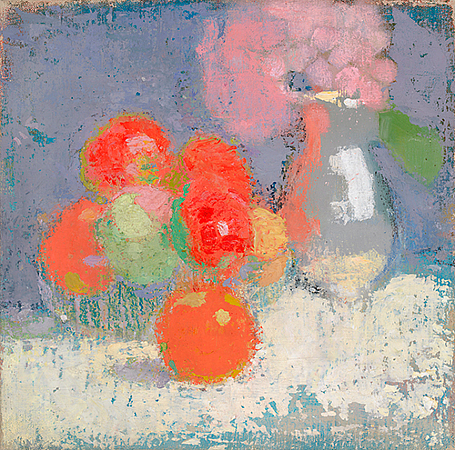
Photo: Finnish National Gallery / Hannu Aaltonen
Red Apples
1915
oil on canvas
Collection Yrjö & Nanny Kaunisto,
Ateneum Art Museum, Finnish National Gallery
Read more
In the 1910s, Helene Schjerfbeck’s still lifes became a reflection of the artist’s personal concept of light and color. Her use of the palette knife is no longer used to depict the material of the subject, but to organize the whole basic structure of the picture. Red Apples (with hydrangea in a silver vase in the background) is painted in bright, sensuously glowing colors. The light source is even, which emphasizes the intensity of saturation. A single green apple is centered, providing the contrasting complementary color, just as the orange contrasts with the violet background. Red Apples marks an important change in Schjerfbeck’s work, as the use of color starts to take on an autonomous element in her painting.
Girl from Eydtkuhne II
1927
oil on canvas
Collection Yrjö & Nanny Kaunisto,
Ateneum Art Museum, Finnish National Gallery
Read more
Paintings of modern women form the majority of Helene Schjerfbeck’s work from the 1920s.
Girl from Eydtkuhne II (1927) was painted after a great change had taken place in the artist’s life. Following her mother’s death, Schjerfbeck, who was herself growing old, moved to the small coastal town of Tammisaari. She yearned for the freedom and peace of mind needed to paint. She corresponded actively with her artist friends and kept in touch with the art world through books and periodicals. She was particularly interested in Paris, where she had studied in her youth, and in its fashion, which inspired her not only to paint but also to design and make her own clothes.
The periodicals were a door to a modern world where fashion and art joined in new ways that inspired many contemporary artists. According to the French poet Charles Baudelaire, art and beauty consisted of an eternal and invariable element on the one hand and a relative, circumstantial element on the other. Fashion became the relative, circumstantial, and modern expression of beauty. The idea fascinated Schjerfbeck, who knew of the poet’s theses and was so attracted to the portraits of fashionable women painted by Constantin Guys, whom Baudelaire called the “painter of modern life,” that she made several variants of them.
Images of the modern woman became symbols of a new, more democratic world. Helene Schjerfbeck painted professional, independent women who were aware of their position and who dressed and made up in keeping with contemporary fashion. She was not interested in her models as persons and the paintings were not portraits in a conventional sense. They were more like carefully crafted figures of a new type of woman who had been born out of modernization.
The fragile, long-necked figure of the Girl from Eydtkuhne is clearly the same modern woman who so often appears in Schjerfbeck’s paintings from the 1920s and on the pages of fashion magazines. The work alludes to art phenomena that interested Helene, cubism influenced by Cezanne and japonism that created suspense between the person and the background. The treatment of the surface is typical of Schjerfbeck: the layers of paint have been worked, color added and wiped off and the background left unfinished and sketch-like.
Sigrid Schauman (1877–1979)
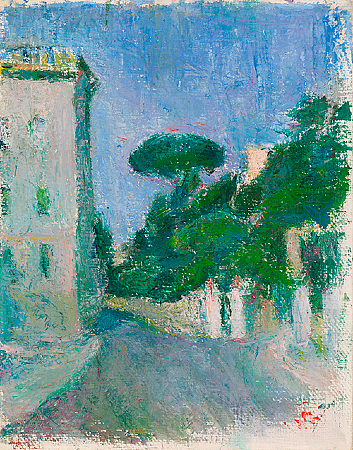
Photo: Finnish National Gallery / Jenni Nurminen.
Italian Landscape
1930s
oil on canvas
Collection Antell,
Ateneum Art Museum, Finnish National Gallery
Read more
Sigrid Schauman was both an exceptional woman and artist for her time, in that she succeeded in combining the professions of an artist and critic with her private life as a single parent. It is clear from Schauman’s creative output that she sought to develop as an artist by adhering to the same principles she applied in her criticism of the art of others. Her main preoccupation both as critic and artist was with colour and light. In her early work at the beginning of the 20th century, Schauman adhered to tonal painting using a palette of earthy greys and browns. On her travels to Italy with Ellen Thesleff between 1908 and 1914, Schauman became interested in chromatic contrasts, her palette grew brighter and her style began to shift towards a predominance of light and colour.
Italian Landscape is representative of the colourful landscapes Schauman painted, particularly ones of scenes in France and Italy in the 1930s, which she revisited later after retiring from her career as a critic. Around this time, her subjects were parks, trees and gardens and urban views and people, painted with a palette dominated by tones of blue and green. Schauman often used a palette knife to paint, a technique she and Thesleff took to in Italy in 1908, among the first Finnish painters to do so. In both her creative and critical work, Schauman emphasised painterliness and emotional aesthetics: she felt that a work should first and foremost appeal to the viewer’s emotions and draw its subject matter from real life.
Schauman evolved as an artist throughout her life and reached her peak of creativity relatively late, when she was over 70. In 1949 she travelled to southern France to devote herself entirely to painting. In the Mediterranean light, her landscapes radiating light and colour came into full bloom.
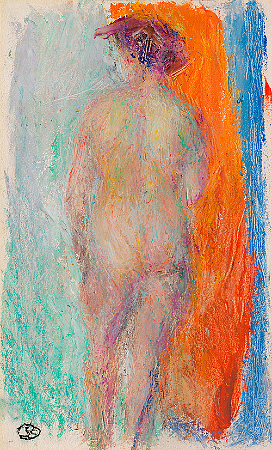
Foto: Finnish National Gallery / Jenni Nurminen.
Model
c. 1958
oil on canvas
Ateneum Art Museum, Finnish National Gallery
Read more
Nudes are perhaps the most classical subject in the history of art. The earliest known examples of nudes are the Willendorf Venus and the Cycladic marble idols. The cornerstone of Western art was of course laid in classical Greece. Copies of the most important Greek sculptures spread around the Roman Empire and eventually copies of copies wound up in museum collections and art academies in the 19th century. It is not by coincidence that students at academies used plaster copies of ancient sculptures as their models.
In the 19th century, European art academies still applied restrictions on women working with live models. In the 20th century these restrictions were removed. Gender was no longer a barrier to viewing or painting a nude human.
Schauman discovered nudes as a subject in the 1950s after having painted landscapes and portraits for decades. She first entered nudes in an exhibition in 1953. Her nudes are studies of color and light, and the human body merely provided a path towards the perfect painting. The woman or her body as such had no particular significance.
In this respect Model (circa 1958) is different from her other nudes. It depicts a woman whose head and right arm are positioned as if she were about to speak or move at any moment. She is much more than a mere object of depiction or someone’s gaze.
Schauman believed that color, line and composition should directly impact emotions. This is obvious from the composition of the painting. The model is placed within intense fields of color, with turquoise on the left and orange bordered with blue on the right. Attention is also drawn to Schauman’s way of creating emphasis by scraping the surface of the paint or drawing marks across it with a palette knife. She has also cropped the picture in an unusual way, cutting off the ankles and feet.
The rotundity and softness of the woman’s features are repeated in the hues and bathe in the painting’s internal light. It is not an exaggeration to say that Schauman painted people as if they were beautiful landscapes.
Self-Portrait
undated
oil on canvas
Ateneum Art Museum, Finnish National Gallery
Read more
Sigrid Schauman lived an exceptionally long and varied life. She was even alive to see her centennial exhibition held in Helsinki in 1978. Schauman retained a keen interest in the portrayal of people throughout her life. She was particularly fascinated by self-portraiture and painted many early on in her career. Schauman’s self-portraits tend to be in the same format, with the face and upper body seen frontally or from a slight angle, the most typical portrait format. Some of Schauman’s self-portraits show only the face without any attributes indicating her profession, as in this undated Self-Portrait.
A common criterion for a successful portrait is its likeness with the sitter. In Schauman’s early self-portraits, the artist meets the viewer’s gaze directly and with candour, but the realism and identifiability of the figure gradually disappeared as her technique evolved. Schauman painted many unconventional portraits that lack clear facial features. When she began making self-portraits again in the 1930s, she painted them with the same method as her landscapes, applying the paint in thick layers with a palette knife or manipulating it with her fingers. Schauman’s late period is characterised by the predominance of light, shadow and massed colour. She often depicted the figure in strong backlight, blurring the sitter’s facial features. In this Self-Portrait, evidently from Schauman’s late period, part of the canvas remains unpainted. All of Schauman’s pictures are nevertheless carefully considered, although at first glance they may seem unfinished. This tightly framed picture is a psychological facial portrait in which the artist examines her ageing self with an utter lack of sentimentality.
Elga Sesemann (1922–2007)
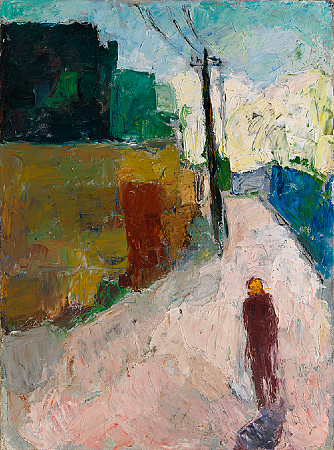
Photo: Finnish National Gallery / Jenni Nurminen.
Street
1945
oil on canvas
Ateneum Art Museum, Finnish National Gallery
Read more
Elga Sesemann painted Street in 1945, after the end of the Second World War. Finland’s wars, the Winter War of 1939–1940 and the Continuation War of 1941–1944, had left their mark on the country. Lapland, the northernmost part of Finland, had been burned, and the capital Helsinki in particular had suffered heavily from aerial bombing. Ordinary families — women and children — had fled the war from the city to the countryside. Children had also been sent to Sweden to safety. Life in the city had become difficult.
In post-war Finland, artists depicted the country and its rebuilding. Materials were hard to come by and the quality of canvas varied. When canvas was not available, artists painted on cardboard. Paintings were often small and could be carried under one’s arm.
Sesemann’s Street depicts an urban scene. In 1940, war forced the Sesemann family to leave the Finnish town of Viipuri, close to the Soviet border, and move to Helsinki. The artist learned to know her new hometown by drawing and painting it.
The buildings in the painting appear massive and their outlines are pronounced. Telephone lines cut through the air and highlight the importance of contact between people in a city that was otherwise so empty. The unusually brilliant whiteness of the street also draws attention. It is painted in slightly colder hues than the warm, glowing sky of the horizon.
Sesemann had a fierce, almost rebellious painting technique. Despite a general shortage of everything, she applied thick layers of paint not with a brush but with a palette knife. This lends her paintings their typical sense of materiality.
The painting includes a solitary human figure walking in the street, followed by its shadow. Moving towards the light, the figure provides a scale for the urban landscape and is also a touching symbol of how people will always reclaim a space, despite the ravages of war.
In fact, the painting can be viewed not only as a depiction of our endless solitude but also of hope and a better future.
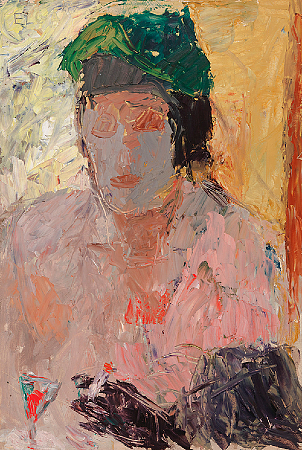
Photo: Finnish National Gallery / Hannu Aaltonen.
At a Café
1945
oil on cardboar
Ateneum Art Museum, Finnish National Gallery
Read more
Elga Sesemann studied in the mid-1940s at the school of the Finnish Fine Arts Academy (formerly the Finnish Art Society’s drawing school), and her first solo exhibition took place in Helsinki in 1945. Sesemann never joined any particular group or school but instead developed a style of her own already as a student. From her earliest works she was a modernist, drawing inspiration from a range of movements and distilling them to a distinctive idiom of her own. Her interests included surrealism, metaphysical art and Edvard Munch’s symbolist expressionism. The intense coloristic style she presented in her debut exhibition was created by applying thick layers of oil paint with a palette knife, although she subsequently began using pastels and gouaches as well.
Critics of the day praised Sesemann for her bold use of colour but complained about the noncommittal approach to form. For the contemporary viewer, the compositions seem deliberately sketch-like and boldly modernist. Distortion of the figure is also a key stylistic element in expressionism.
At a Café brings together key themes in the depiction of the modern woman: a modernist approach, deploying thick layers of paint and resulting in a plaster-like texture, and the figure of an independent woman, a new type who appeared in the urban landscape the 1920s and 1930s. A ‘New Woman’ like this could be spotted sitting alone in a café without any male companion, with a cocktail glass in front of her and smoking a cigarette. In this picture, the layer of paint that obscures the woman’s face and the smudged eyes resemble a mask hiding her genuine personality. The mask is a common motif in post-war portraiture. It can be seen as an allegory of general experiences of alienation and horror — a mask gives a sense of security and also allows for role play.
The Flower Seller
1946
oil on cardboard
Ateneum Art Museum, Finnish National Gallery
Read more
From 1945–1946 Elga Sesemann painted at a furious pace, her expressionist style intensifying and becoming increasingly sketch-like. The recurring motifs in her work from this period are lone figures on beaches, dreamlike deserted urban views, and literary themes. Many of the pictures display a melancholy mood typical of the post-war era. The war and shifts in worldview and politics that it led to were felt acutely by artists, who expressed their feelings obliquely, through distancing and deliberate alienation, and by conceptualising their themes. This applied also to Elga Sesemann, whose interest in metaphysics intensified.
In contrast to many modernists, Sesemann did not idolise urban life and its symbols — cities, machines and traffic — seeing them instead as threatening while also being fascinated by them. Acutely aware of modern alienation, she devoured literature and philosophy, and was especially interested in Albert Camus and Martin Heidegger. Their thoughts seem to have fascinated Sesemann, who herself had lived in the margin, cut off from the security of her large family when she left her native region to flee the war. In the captivating urban character studies and landscapes she made in the 1940s, tinged with melancholia, existential alienation and a sense of otherness, Sesemann (then in her twenties) confronts the trauma of wartime distress and loss. Although the works are often stylistically expressionistic, they lend themselves to interpretation in the context of metaphysical art. In terms of elements and style, The Flower Seller can also be linked to German expressionism. The colour planes are outlined sharply with black, and the dramatic perspective from on high creates a tension in the space between the two buildings.
Ellen Thesleff (1869–1954)
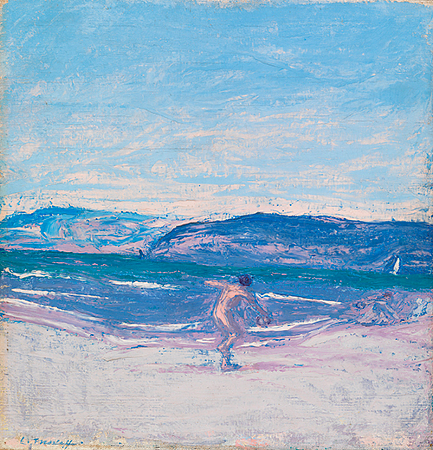
Photo: Finnish National Gallery / Hannu Pakarinen
Ball Game (Forte dei Marmi)
1909
oil on canvas
Ateneum Art Museum, Finnish National Gallery
Read more
People playing sports first appeared in Thesleff’s paintings in 1909, when she spent a summer in the Italian seaside town of Forte dei Marmi. Many of her works from that period feature people enjoying fashionable outdoor activities. She was especially interested in the depiction of movement and dance as well as classical art. The people on the shore in her pictures are vigorous and strong — statuesque.
A healthy and athletic lifestyle matched Thesleff’s vitalistic mentality, whereby nature and humanity are closely connected. This painting is a prime example of the stylistic renewal that took place in Thesleff’s work in this period. The colours of her pure palette are applied liberally on the canvas using broad strokes and a palette knife.
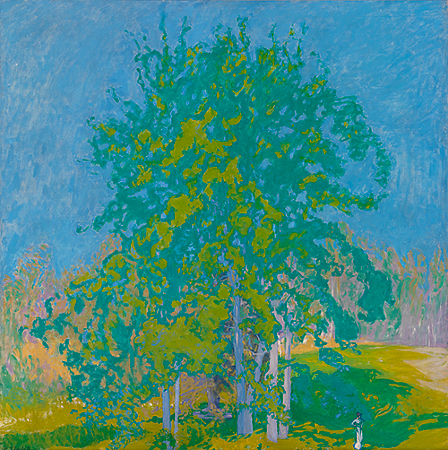
Photo: Finnish National Gallery / Yehia Eweis.
Decorative Landscape
1910
oil on canvas
Ateneum Art Museum, Finnish National Gallery
Read more
Around the turn of the century, many artists embraced the philosophy of vitalism, the idea that a life force, élan vital, governs the lives of humans in the same way that natural forces govern nature. According to this philosophy, the life force could be found in open air, water, earth and sun and could be mobilised by instinctive action. Spiritual and physical wellbeing were inextricable from each other. In art nature was no longer synonymous with a mere landscape, and the concept expanded to signify the entire universe. This idea was adopted by Ellen Thesleff, who drew inspiration from the natural surroundings both on trips to Italy and at home in Central Finland. For Thesleff vitalist thinking represented an amalgamation of nature, landscape and humanity. She expressed this view in her works through careful consideration of composition, palette and the depiction of sunlight and motion. Decorative Landscape communicates Thesleff’s powerful emotional experience through its proportions: the picture is dominated by the magnificent figure of a huge tree bathed in intense light and colour. The female figure under the tree is tiny in relation to the surrounding nature, her pose suggesting loose clothing, which allows freedom of movement.
In the early 1900s, the word ‘decorative’ was still applied in art criticism to works that were considered inconsequential in some way. A few years later, around 1908–1910, colour began to gain in importance in the European modernist view of art. In Finland, this period has been deemed a time of ‘pure palette’. Ellen Thesleff is one of the first Finnish artists in whose work and thinking purity of colour finds a corollary in abstract beauty and also music, considered the highest form of art. Music was, along with nature, an important source of inspiration for Thesleff, who came from a musical family. Decorative Landscape represents her views on art and life at their purest – pure colour and intense light, a suggestive experience of nature, and a vitalistic view of life, with the human being becoming part of the universe.
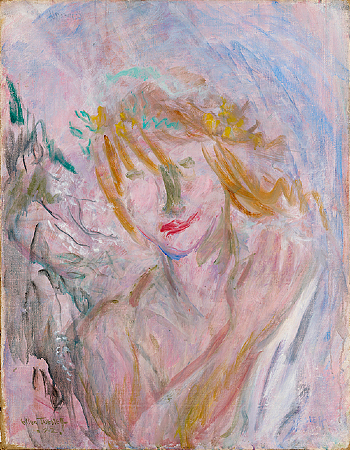
Photo: Finnish National Gallery / Hannu Pakarinen.
Finland's Spring
1942
oil on canvas
Ateneum Art Museum, Finnish National Gallery
Read more
Finland’s Spring was painted during the Continuation War (1941–1944). Despite the sociopolitical upheaval, Thesleff continued her thematic exploration of Vitalism, while drawing inspiration from Renaissance masters. Admiring Sandro Botticelli, her series Finland’s Spring – a collection of woodcuts from the 1930s that culminates in this painting – depicts a youg girl as an allegorical reference to spring. During the early 20th century, nature was often used as a motif to represent a person’s spiritual life where health and well-being were dependent on the interrelationship between man and the ‘natural’ world. Thesleff’s interest in Kineticism is depicted through the sketchily applied marks of pink and blue. Along with the title, the bright palette and active brushstroke suggest an optimistic view of things to come.